


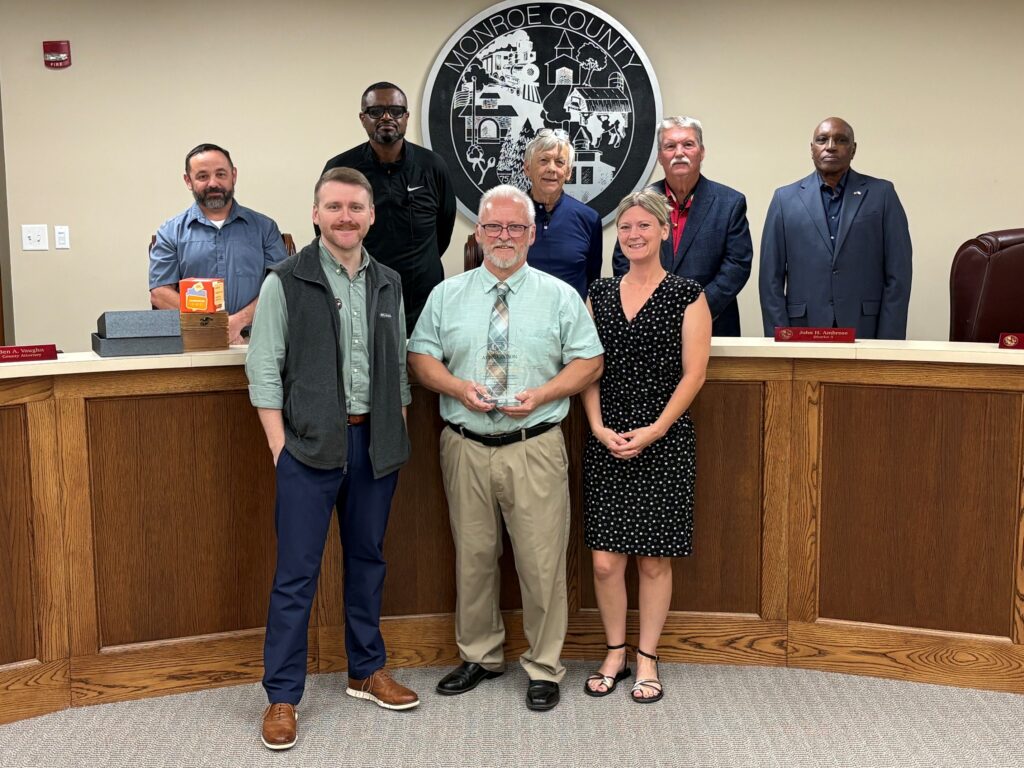
Monroe County Commissioners honored on Tuesday, Nov. 3 recently retired Monroe County Magistrate Judge Frank “Buck” N. Wilder IV by presenting him with a special plaque and several small gifts of appreciation. Wilder, who stepped down last month after 34 memorable years on the bench, reflected on his distinguished career as he exited office.
With no judicial background, Wilder first took office in 1985 at the tender age of 25 years old. Wilder recalled his first office was in the basement of the Monroe County Courthouse and the very first preliminary hearing he ever saw is one he presided over himself.
Wilder initially became interested in becoming Magistrate Judge when he was serving as a Forsyth police officer in his early 20s and used to visit then-Monroe County Magistrate Judge Auby Sutton in his office. Wilder said he figured Sutton would serve one more term and then retire, at which time Wilder would run as a 28-year-old when “people would take me a little more seriously.” Instead, Sutton passed away while in office, and local attorney Elmo Remick was appointed to serve the remainder of Sutton’s term. When the position came open less than a year later, Wilder defeated two other candidates to become one of the youngest (if not the youngest) judges in county history.
Wilder, who described himself as “scared to death” when he first took office, said the only training he received was through a 40-hour course at the University of Georgia School of Law. Wilder, who grew up fascinated by crime books, said he fared well in some criminal justice and criminal procedures classes while an undergraduate student but did not have any sort of law or criminal justice degree.
“There wasn’t anybody there to teach me,” Wilder said.
Wilder said he quickly went to work teaching himself, reading law books and researching all the time.
“My then-wife told me, ‘You’re not fun anymore,’” Wilder recalled. “Because I took these books home, and I was really studying. I realize what she said. I was fully immersed. But I had to be because everybody thought I had the answers. Just because you’re elected, they think you have the answers. So I let my common sense rule me in dealing with things. Usually, not always, but usually what’s morally right is also legally right.”
Wilder said most of the counsel he received in his early days came either from then-Magistrate Court Clerk Diane Williams or veteran Monroe County Superior Court Judge Hugh Sosebee Sr.
Wilder said, “Judge Sosebee was kind of my mentor, but I would only go to him if I just flat could not find the answer because I didn’t want to bother him. . . He wouldn’t tell me the answer. He would put things in the proper perspective. He would take a complex issue and make it simple, and I would figure it out on my own.”
In a small town like Forsyth in the 1980s, Wilder said he frequently knew both the plaintiffs and the defendants, but the only time he would recuse himself is if he socialized with one of the people involved. Wilder said there were many times though when he had to remind people in his courtroom that he was not to be addressed as “Buck” at that moment, but “Judge Wilder.”
“You want to hear a funny story,” Wilder said. “I was at a preliminary hearing, and it was a pretty serious aggravated assault case. The guy was standing outside a truck and hit the other guy across the face with a pipe. And I knew the victim. Elmo (Remick) was representing the defendant, and he said something to this guy, and this guy says, ‘That’s bull—-,’ in my courtroom. That just flew all over me. I grabbed that guy. I said, ‘Recess! Get in my office!’ My office was right there beside the courtroom. I walked in there and raked him up and down. I said, ‘When I’m in that courtroom, I’m not Buck. I’m a judge of this court. And if you ever talk in that way, I’m going to hold you in contempt of court. I’m not Buck when I’m in there. And don’t you forget it.’ And then I asked, ‘What do you have to say?’ And he said, ‘I like Buck a whole lot better than that guy in there.’”
An early case that shaped Wilder’s future as a judge was when a woman narrowly survived a vicious beating at the hands of her husband after Wilder had issued a peace warrant in the case.
Wilder remembered, “I’ll never forget it. . . That was horrific. And that was what got me interested in domestic violence. I couldn’t sleep. I had insomnia about the job. So I stayed up late and caught a New Jersey network show called, ‘Battered Wives, Shattered Lives.’ I watched this video, and it talked about New Jersey and what they’re doing. I said, ‘Man, we’re doing this wrong here.’”
Wilder said he went to work studying domestic violence laws and began speaking at Georgia Senate subcommittee hearings around the state. Wilder said the biggest problem was that the only domestic violence training that rookie law enforcement officers received was a small part of a four-hour mandate school class called. ‘Interpersonal Communications.’ Wilder said it wasn’t uncommon for veteran law enforcement officers who had never had any kind of formal domestic violence training to mentor young officers and much of what they may have learned in their brief mandate course was lost.
Wilder said he decided to take action by developing a 40-hour domestic violence course to be taught at Monroe County’s own Georgia Public Safety Training Center (GPSTC), and Wilder even agreed to teach the class. Wilder said his work on domestic violence helped lead to changes in Georgia law that now require deputies to make an arrest if there’s probable cause in a domestic violence case. Wilder even taught other Magistrate Judges around the state about better ways for handling domestic violence. His work eventually got him appointed by Gov. Zell Miller during the 1990s to serve on the state’s first-ever Family Violence Task Force.
Despite Wilder’s best efforts in his judicial rulings, some tragedies were often unavoidable. Wilder said the worst day he ever experienced on the job came in October 1999 when a young woman was callously murdered by her ex-boyfriend on the Monroe County Courthouse square. Wilder said the victim was leaving his office just before being shot three times outside the courthouse. Wilder recalled that the gunman believed that the judge intended to take out an arrest warrant on him for stalking, which would have violated terms of his parole and meant prison time. Wilder said what the shooter didn’t know is that he had just rejected the victim’s warrant request because there was no physical evidence or witness evidence that could be corroborated indicating her ex-boyfriend had stalked her. Wilder said both parties had sat through a mediation hearing in his office just three days earlier and agreed to stay away from one another. Wilder said when he climbed the stairs after hearing the gunshots, he saw with his own eyes the horrific scene that had just unfolded.
Wilder said of the shooter: “He looked at me and said, ‘I know I’m going to jail, but if I’m going to jail, I’m going for something I did, not something I didn’t do.’ I said, ‘Man, she didn’t take a warrant on you.’ He thought she’d taken a warrant. That’s a true story.”
Wilder said the tragedy hit home even harder several weeks later when he had a chance encounter with the victim’s mother, and she asked him to tell her what really happened that resulted in the murder.
Wilder said, “I told her exactly what happened. I didn’t leave anything out. She said, ‘Some people said you didn’t give her a warrant.’ I said, ‘Ma’am, if she’d had a warrant, she could have had 20 warrants, and she’d have died with them in her hand.’ That wouldn’t have stopped him. A restraining order won’t stop anybody if they don’t care about their freedom. That’s the worst experience I had.”
Fortunately, most of Wilder’s days on the bench were much more enjoyable and often involved a lot of laughs. Wilder remembered one time when despite his bailiff E.C. McKinley’s best efforts to help him, he got his judicial robe entangled on the wheel of his chair while court attendees had risen to his presence. Wilder said when he couldn’t free the garment from the chair, the chair tipped up and he went down to the floor as he told the audience to hysterical laughs: ‘You may be seated.’ Another time Wilder remembered a trio of defendants accused of stealing a vehicle who all had an unusual way of saying the state name, ‘Mississippi,’ which evoked great amusement for the judge and attorneys alike.
As Magistrate Judge, Wilder also had the pleasure of officiating literally hundreds of Monroe County weddings, some of which were quite memorable. Wilder, who is also an accomplished singer and musician, said it wasn’t uncommon for him not only to officiate the ceremony but also to provide the musical entertainment at the wedding and/or the reception.
“I’ve done them everywhere,” Wilder said of officiating weddings. “I’ve done them in my yard. I’ve had people come to my house like Andy Griffith. I’ve done them on boats in the middle of Lake Juilette, locks, bridges, down in the woods by a creek.”
Wilder said he even did a wedding on the old High Falls bridge prior to the bridge’s destruction in the Flood of 94 in which the best man was a labrador retriever who had a stick in his mouth with the rings on it.
“I didn’t know that going out there,” Wilder said of the best man’s unexpected four-legged appearance. “Weddings are serious stuff to me.”
Wilder eventually stopped officiating weddings a few years back because they were taking up so many of his weekends. However, he said now that’s he retired, he might get back into it.
“I enjoy doing weddings,” Wilder said. “Normally, I deal with people at their worst. Because whenever you make a decision, somebody’s mad. But a wedding, they’re generally at their best. It’s nice to have everybody smiling.”
In addition to being a judge, Wilder is well-known around Middle Georgia for his musical talents. He was the house performer for decades at Forsyth’s landmark bar, C.T.’s Bar & Grill. He also had a brief stint as the co-owner of the Forsyth café/nightclub, The Left Banque, where Grits and The Rose Theater now stand today. Wilder said The Left Banque was the place to go in the 1990s.
“You would not have believed it,” Wilder said. “We had Clarence Carter, The Coasters, The Drifters, the Swingin’ Medallions. We had a comedy night. I mean it was a full-fledged club. We sold steaks. We even had a Mardi Gras one time. I cooked shrimp, crawfish, big jambalaya. We did a supper buffet, and then I got up and told my stories. It was quite successful.”
Wilder said he was often asked how he could be a judge by day and a country music singer by night.
Wilder said, “I always said, ‘It’s a small town, and I’d been doing music already when I was elected.’ And of course, I’ve always conducted myself in a proper way.”
Wilder said being a husband, father, judge, gardener, and musician meant some long days and nights. Eventually, in 2004, he decided it was time to retire from the Magistrate Court. He said his decision was less about being too busy but more so that technology was not yet advanced enough that he could do his job without actually going to the courthouse.
Wilder said when he returned to the bench in 2012, everything was much easier to do remotely.
“If I’m in the garden, I get on the phone. I can reach them (law enforcement officers) on Skype or FaceTime and swear them,” Wilder said. “I call them first, and they tell me what happened and discuss whether they’ve got probable cause. I ask them to stand by, and I Skype them and swear them. And then the warrant goes to the radio room. It’s great. If I had had that in 2004, I wouldn’t have left.”
Wilder said search warrant requests are often more time-consuming, and he said his court’s caseload is ever increasing. He said because the Department of Corrections offices are located in Forsyth, the Monroe County Magistrate Court handles garnishments for the whole state correctional system. He said he also issues search warrants for cell phones for the Department of Corrections because Burruss Correctional Training Facility in Monroe County has the technology to access phone data. Wilder said search warrant requests are among the most interesting parts of his job.
“You’ve really got to scrutinize those things,” Wilder said of search warrant requests. “Arresting somebody and taking their freedom, that’s serious stuff of course. But when you sign that search warrant, you’re authorizing the state to come in your house and look through anything in your house where what they’re looking for could be. If they do, it’s okay as long as what they’re looking for could have been there. For example, if you’re looking for a 90-inch TV, you can’t pull out a drawer and look in there and find contraband. But if they’re looking for a knife, and they pull out a pound of dope, the dope’s going in.”
Wilder said the biggest change from his job in the early years to present time is that judges are no longer allowed to have private communication with people coming before their court. Wilder said his office was “like a doctor’s office” in the early years, where he frequently offered wisdom and advice. But Wilder said the state’s Judicial Qualifications Commission (JQC), which has eliminated ex parte (one party) communication, is now mostly made up of big-city lawyer-magistrates who think like attorneys.
Wilder said of the changing state laws: “They’ve complicated the court to where it’s more difficult for lay people to come in. You never tell somebody how to present their case. You can only explain procedure. But back then I could make a phone call.”
Wilder said his first 20 years as judge were challenging because of the sheer volume of visitors and phone calls he got. In contrast, he said the difficult part of his second stint as Magistrate Judge beginning in 2013 has been the isolation.
“People get frustrated because they want you to help them,” Wilder said. “But you’re not allowed. The judge is neutral and if you talk to one side, you’ve got to call the other side and tell them what you talked about and give them the opportunity. So it’s best just not to talk to anybody and just hear it in the courtroom. From a technical standpoint, that’s the best way to do it. But I knew when I could hear a case and when I couldn’t. I knew if I was biased. If I was already formulating an opinion, I would just not hear the case. But if I could make a fair decision, I just knew I could. I knew me. If I had any, or the appearance of somebody being biased, I would step back from it because I don’t want anyone feeling that way.”
As Wilder retires from the bench for the second and final time, his longtime assistant, Margie Bittick, has been tapped to take his place as Chief Magistrate Judge. Wilder said Bittick is ready to take on the challenge.
“I trained her for this job, and she took to it,” Wilder said of Bittick. “She gets it. She gets what we’re doing. And she’s a natural at doing research and finding the answers. That’s the big part. She came up from revenue. She started out as a clerk and ended up regional manager. She’s really smart. . . Margie’s at a stage now where everything is so fresh. There’s so much to learn. And she’s good at it.”